
Results
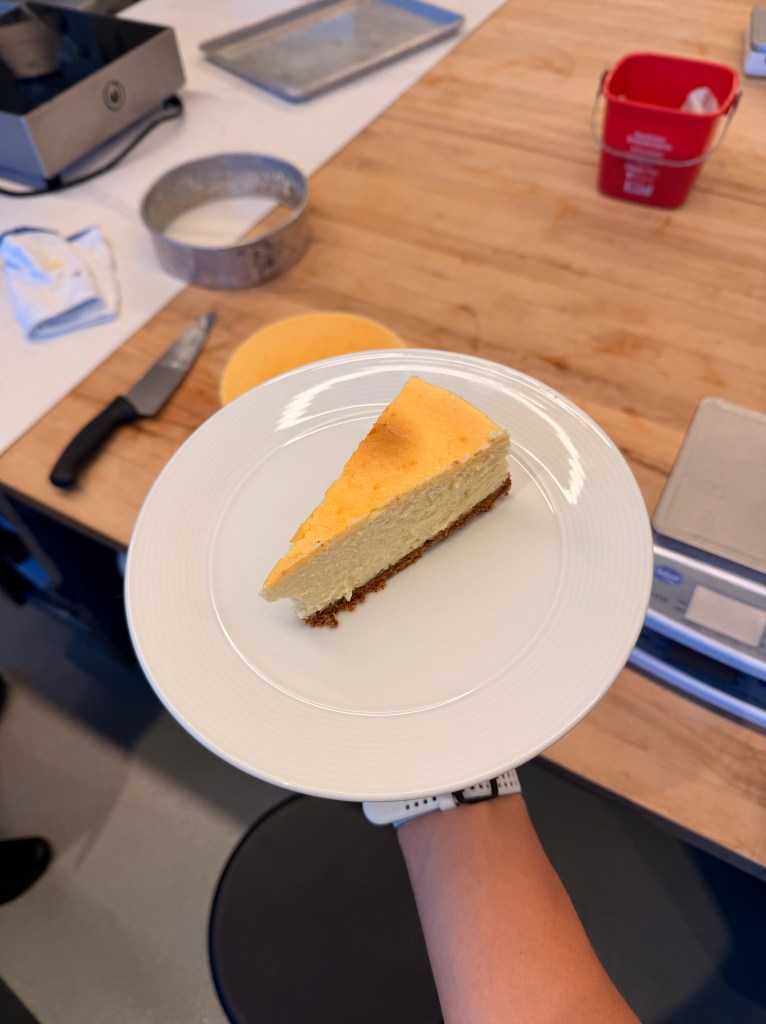
For this lab, we prepared two classic custard-based desserts: baked cheesecake and crème brûlée. Our cheesecake baked evenly, had a smooth texture, and developed a rich yet balanced flavor. The structure held well, with no cracking and a creamy interior.
The crème brûlée, while ultimately successful, took significantly longer to bake than expected. Despite the extended bake time, the custard eventually set properly and maintained a velvety consistency with a clean, smooth break when spooned.
Evaluation of Results
Cheesecake is a form of baked custard stabilized by cream cheese, eggs, and sometimes sour cream. A successful cheesecake should be creamy, slightly firm at the edges, and just set in the center. Ours met these standards well. According to On Food and Cooking, custard mixtures coagulate between 160–180°F, and controlling the bake environment prevents curdling and cracks (McGee, 2004). Our even baking and lack of cracking suggest that our oven temperature and water bath created the ideal controlled environment.
Crème brûlée relies on a delicate balance of egg yolks, sugar, and cream, baked in a low oven in a bain-marie. Our primary challenge was the extended baking time, which can occur for a few reasons:
- Oven running slightly cool
- Water bath not hot enough
- Overfilled ramekins
- Placed too close together, restricting airflow
Professional pastry sources note that crème brûlée typically requires 30–45 minutes at 300–325°F, but can take longer if heat transfer is inefficient (Labensky & Hause, Professional Cooking). Despite this, the custard ultimately set correctly, which indicates that while the timing was delayed, the mixture was balanced and properly emulsified.
Both results reinforced an important culinary principle: custards are doneness-by-sensory rather than strictly timed. A jiggle test, internal temperature (around 170°F), and visual cues determine success more accurately than the clock.
Conclusion
Overall, the custard lab was successful and demonstrated strong technical execution. The cheesecake performed exceptionally, with ideal texture, structure, and flavor. The crème brûlée presented a time-related challenge, but the final product still achieved the smooth, delicate set characteristic of a well-made custard. This experience emphasized the importance of heat control, patience, and sensory evaluation when working with custard-based desserts. Going forward, verifying oven calibration and monitoring water bath temperatures could help streamline bake times and ensure consistent results.
Works Cited
McGee, Harold. On Food and Cooking: The Science and Lore of the Kitchen. Scribner, 2004.
Labensky, Sarah R., and Alan M. Hause. Professional Cooking. Pearson, latest edition.
Gisslen, Wayne. Professional Baking. Wiley, latest edition.
 Jack Burke
Leave a comment